
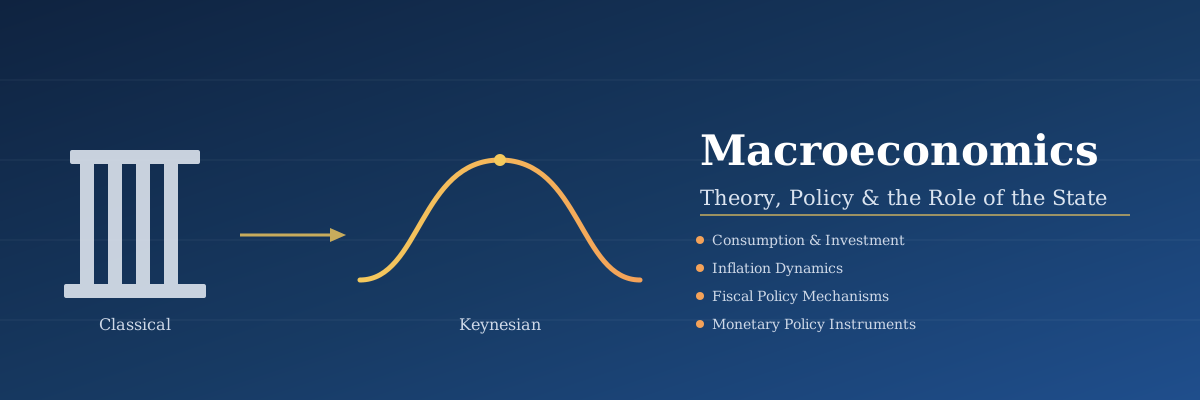
This course introduces students to the theoretical foundations of Macroeconomics, tracing the evolution of macroeconomic thought from the Classical school to the Keynesian Revolution, and examining the expanding role of the state in economic management. Students will engage with core theories of consumption and investment behaviour, the dynamics of inflation, and the mechanisms through which fiscal and monetary policy operate. By the end of the course, students will be equipped to critically analyze macroeconomic policy debates and understand the theoretical underpinnings of state intervention in modern economies.
- Teacher: Swathy Varma P R
Analyze the nuances of subjective and objective poetry
Evaluate the schools and movements of poetry in the prescribed texts.
Evaluate short stories on the basis of content and form.
Interpret folk tales and fairy tales and their functions.
Create original interpretations and responses to literary works through critical analysis and scholarly discourse.
- Teacher: Tania Mary Vivera

Discuss the basic concepts of linguistics and linguistic analysis
Examine the phonetic and phonological processes involved in speech production
Analyse syntactic and semantic processes to enhance awareness about the transformational and generative features of natural language.
Analyse linguistic structures of everyday language.
Appraise the contextual use of language through the basics of phonetics, phonology, morphology, syntax and semantics
- Teacher: Tania Mary Vivera
Course Outcomes
|
Discuss the themes from literary texts through comparativ analysis |
U |
1,3,8 |
|
|
2 |
Analyse literature through close reading and critical analysis |
An |
|
|
3 |
Analyse the complexities of love and friendship as portrayed in literature |
An |
1,3,8 |
|
4 |
Evaluate how love persists in adversity and entails sacrifice |
E |
1,3,8 |
|
5 ortrayal of lov |
Evaluate the portrayal of alternate sexualities |
||
- Teacher: Jisha John